
Most of us use Windows as our base on our computer. So what is Windows actually? Let's take a look on a short detail regarding of Windows.
As technology evolves, more development coming to each computer operating system and so does Windows. With the latest release of Windows 7 they fix their reputation that fall during Windows Vista release. And Microsoft got the award for being the fastest selling operating system than Mac OS X Snow Leopard.

Windows 7 : The Latest Release of Windows Operating System
Microsoft Windows is a series of software operating systems and graphical user interfaces produced by Microsoft. Microsoft first introduced an operating environment named Windows in November 1985 as an add-on to MS-DOS in response to the growing interest in graphical user interfaces (GUIs). Microsoft Windows came to dominate the world's personal computer market, overtaking Mac OS, which had been introduced previously. As of October 2009, Windows had approximately 91% of the market share of the client operating systems for usage on the Internet. The most recent client version of Windows is Windows 7; the most recent server version is Windows Server 2008 R2; the most recent mobile device version is Windows Mobile 6.5.

People Will Call This As A Fail : Windows Vista
Security Issues
Consumer versions of Windows were originally designed for ease-of-use on a single-user PC without a network connection, and did not have security features built in from the outset. However, Windows NT and its successors are designed for security (including on a network) and multi-user PCs, but were not initially designed with Internet security in mind as much, since, when it was first developed in the early 1990s, Internet use was less prevalent.
These design issues combined with programming errors (e.g. buffer overflows) and the popularity of Windows means that it is a frequent target of computer worm and virus writers. In June 2005, Bruce Schneier’s Counterpane Internet Security reported that it had seen over 1,000 new viruses and worms in the previous six months.
Microsoft releases security patches through its Windows Update service approximately once a month (usually the second Tuesday of the month), although critical updates are made available at shorter intervals when necessary. In versions of Windows after and including Windows 2000 SP3 and Windows XP, updates can be automatically downloaded and installed if the user selects to do so. As a result, Service Pack 2 for Windows XP, as well as Service Pack 1 for Windows Server 2003, were installed by users more quickly than it otherwise might have been.

Windows Update Center on Windows 7
While the Windows 9x series offered the option of having profiles for multiple users, they had no concept of access privileges, and did not allow concurrent access; and so were not true multi-user operating systems. In addition, they implemented only partial memory protection. They were accordingly widely criticised for lack of security.
The Windows NT series of operating systems, by contrast, are true multi-user, and implement absolute memory protection. However, a lot of the advantages of being a true multi-user operating system were nullified by the fact that, prior to Windows Vista, the first user account created during the setup process was an administrator account, which was also the default for new accounts. Though Windows XP did have limited accounts, the majority of home users did not change to an account type with fewer rights – partially due to the number of programs which unnecessarily required administrator rights – and so most home users ran as administrator all the time.
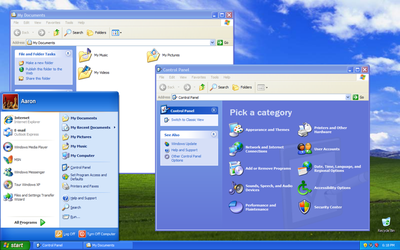
The Famous One : Windows XP also a Windows NT Operating System
Windows Vista changes this by introducing a privilege elevation system called User Account Control. When logging in as a standard user, a logon session is created and a token containing only the most basic privileges is assigned. In this way, the new logon session is incapable of making changes that would affect the entire system. When logging in as a user in the Administrators group, two separate tokens are assigned. The first token contains all privileges typically awarded to an administrator, and the second is a restricted token similar to what a standard user would receive. User applications, including the Windows Shell, are then started with the restricted token, resulting in a reduced privilege environment even under an Administrator account. When an application requests higher privileges or "Run as administrator" is clicked, UAC will prompt for confirmation and, if consent is given (including administrator credentials if the account requesting the elevation is not a member of the administrators group), start the process using the unrestricted token.
File permissions
All Windows versions from Windows NT 3 have been based on a file system permission system referred to as AGLP (Accounts, Global, Local, Permissions) AGDLP which in essence where file permissions are applied to the file/folder in the form of a 'local group' which then has other 'global groups' as members. These global groups then hold other groups or users depending on different Windows versions used. This system varies from other vendor products such as Linux and NetWare due to the 'static' allocation of permission being applied directory to the file or folder. However using this process of AGLP/AGDLP/AGUDLP allows a small number of static permissions to be applied and allows for easy changes to the account groups without reapplying the file permissions on the files and folders.
Windows Defender

A Screenshot of Windows Defender
On January 6, 2005, Microsoft released a Beta version of Microsoft AntiSpyware, based upon the previously released Giant AntiSpyware. On February 14, 2006, Microsoft AntiSpyware became Windows Defender with the release of Beta 2. Windows Defender is a freeware program designed to protect against spyware and other unwanted software. Windows XP and Windows Server 2003 users who have genuine copies of Microsoft Windows can freely download the program from Microsoft's web site, and Windows Defender ships as part of Windows Vista and 7.
Source :
Wikipedia - Microsoft Windows
Wikipedia - Windows Defender


Subscribe to:
Post Comments (Atom)





Post a Comment